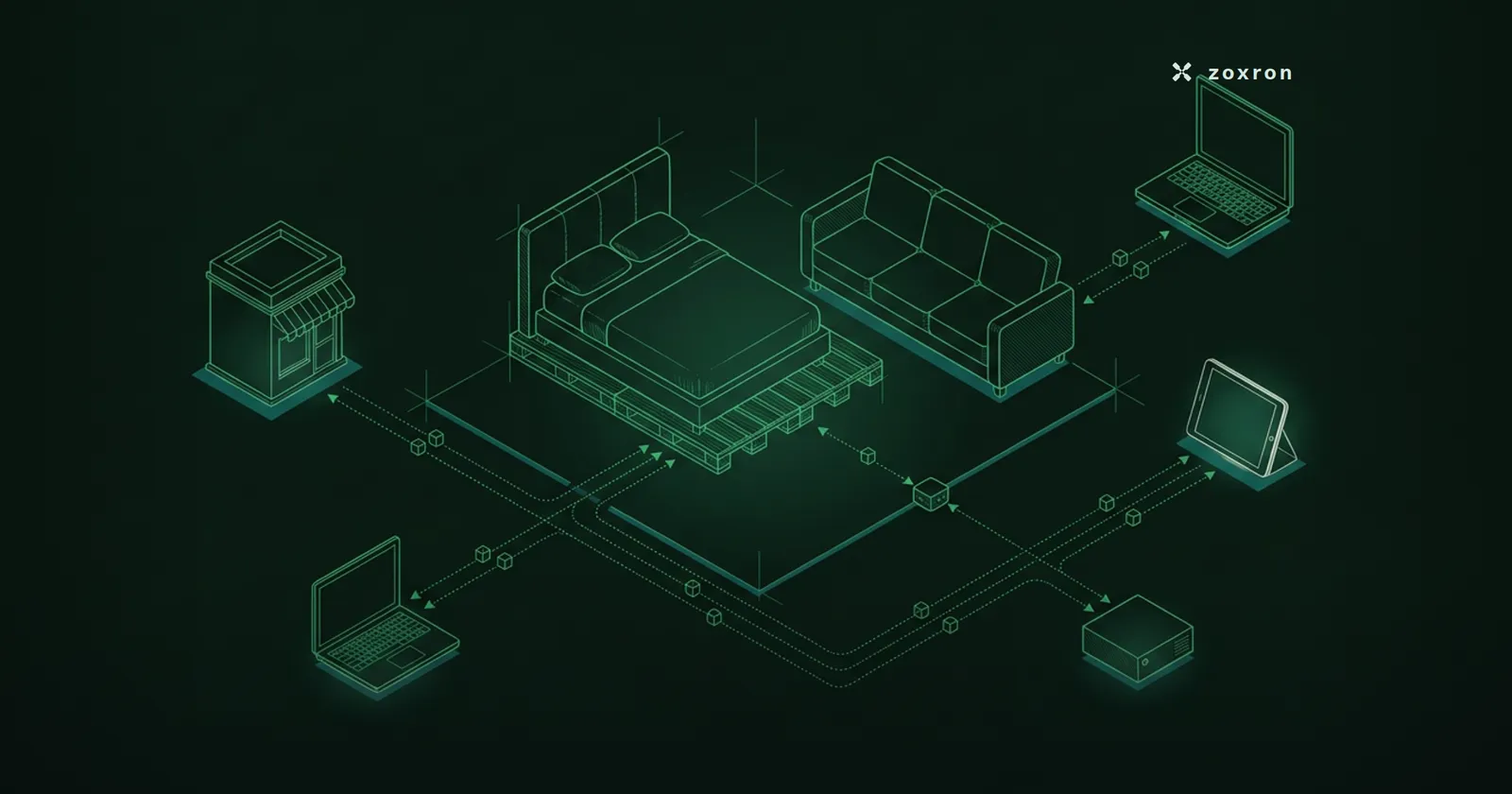
A furniture manufacturer making beds and sofas sells through dozens of dealers: furniture showrooms, webshops, regional distributors. Many of them run their own shop or their own ERP. For years the routine looked the same: someone at the dealer retyped the catalogue and prices, someone else retyped the order into an email, and the manufacturer's office retyped it once more. Every retyped line is a chance for the wrong fabric, the wrong size or last month's price.
The partners already had a portal where they could order on their own. We described what such a portal does in A B2B portal on Odoo that partners actually use. The next step was obvious: let the dealer's system talk to the manufacturer directly. This post shows how a B2B API for partners works in practice, and what it gives both sides.
Why not just open the ERP's built-in API
Odoo, the base this manufacturer runs on, has its own API. It is a good tool for the company's own integrations, but it was never meant to face partners. It shows far more than a dealer should see: internal fields, costs, other customers' data, all depending on access rights that are easy to get wrong.
So we built a separate partner API. It shows exactly what a partner is meant to see, in the shape a partner's developer expects, and nothing more. The ERP stays the single source of truth, and the API is a well-defined window onto it.
What a dealer gets through the API
- A catalogue with their own prices. Products, variants and sizes with prices from the partner's own pricelist, plus product photos and documents such as data sheets and care instructions.
- Orders with validation and freight. The dealer's system sends an order and gets an immediate answer: whether every line is correct and what transport will cost to the delivery address.
- Quotations to accept. When the account manager completes a quotation, the dealer's system can fetch it and accept it.
- Order status, shipments and invoices. The dealer sees where each order stands, follows shipments with tracking and downloads invoices without asking anyone.
- Notifications about changes. Instead of asking every few minutes, the dealer's system receives a webhook when an order is confirmed, a shipment leaves or an invoice is issued.
For the dealer this means current prices and order statuses in their own system, without phone calls and emails. For the manufacturer it means orders that arrive complete and correct, so the office spends its time on customers instead of retyping.

Keys with scopes and limits: each partner gets only what they need
Not every integration needs everything. A partner creates their own API keys in the portal and chooses what each key may do: read the catalogue, read orders, read invoices, or place orders. An agency building a webshop for a dealer gets a key for the catalogue only. The dealer's accounting system gets a key for invoices. Nobody hands out more access than the job requires, and a key can be revoked at any time without touching the others.
A dealer's shop may ask for the catalogue thousands of times a day. That must not slow down the people working in the ERP. Every key has its own request limit, and the catalogue is served from a cache, so answers are fast and one busy partner does not affect anyone else. The office does not notice that dozens of systems are connected.
The account manager stays in control
An API should make selling faster, not let it run on autopilot. Every order that arrives through the API is still confirmed by the account manager on the manufacturer's side, exactly as an order from the portal. Orders from the API also go through the same credit limit and approval that we described in Receivables control in manufacturing: from order to reminder. And if a given partner should only read data for now, placing orders through the API can be switched off for that partner alone.
Accepting a quotation is protected as well. Between the moment the dealer's system fetched a quotation and the moment it accepts it, the account manager may have changed the price, the freight or the delivery date. In that case the API refuses the acceptance and asks the system to fetch the current version. Nobody accepts something different from what they saw, and there is no dispute later about which version was agreed.
Documentation a partner's developer can work with
An API is only as good as its documentation. Partners get public developer documentation in the OpenAPI standard, with examples for every common task: fetch the catalogue, place an order, accept a quotation, receive a webhook. We had the documentation reviewed independently by an AI model several times during the work. Its score rose to 9 out of 10, and the review judged it ready for a pilot with the first partners.
Functional tests run on a test copy of the system, never on live data. Freight quotes are switched off in tests, so carriers do not get flooded with requests for shipments that will never happen. It is a small rule that keeps relations with carriers clean.
Not every partner has a developer: the product file
A small showroom with a ready-made webshop does not need an API. For them there is a simpler channel next to it: a product file in XML, CSV or XLSX, with profiles for popular shop platforms. The partner pastes a link into their shop, and products, prices and photos stay current. The API is for partners who want orders and statuses to flow both ways.
What the manufacturer gets
A manufacturer that gives partners a proper B2B API sells faster and with fewer errors. Dealers connect once and then order from their own system, with prices they can trust. The office stops retyping, the account manager keeps the final word, and integrating the ERP with distributors becomes a standard offer instead of a separate project for each partner. All of it runs on Odoo as the base, while the partner sees only a clean, documented dealer API. We wrote about how we start such projects in manufacturing in ERP in manufacturing: who makes the first move.
FAQ
Can a partner place orders without the manufacturer's approval?
No. Every order from the API is confirmed by the account manager, and it goes through the same credit limit as an order from the portal. Placing orders through the API can also be switched off for a specific partner.
What does a partner need to start using the API?
An account in the partner portal, where they create a key with the scopes they need, and a developer or agency that reads the documentation. Partners without a developer can start with the product file instead.
Will partner integrations slow down our ERP?
Every key has its own request limit, and the catalogue is served from a cache. That keeps the API fast for partners and keeps the load away from the people working in the system.
If your dealers still retype your catalogue and email their orders, let's talk. We start with one question: what your partners should see, and what they should never see. More about how we work on the services page.