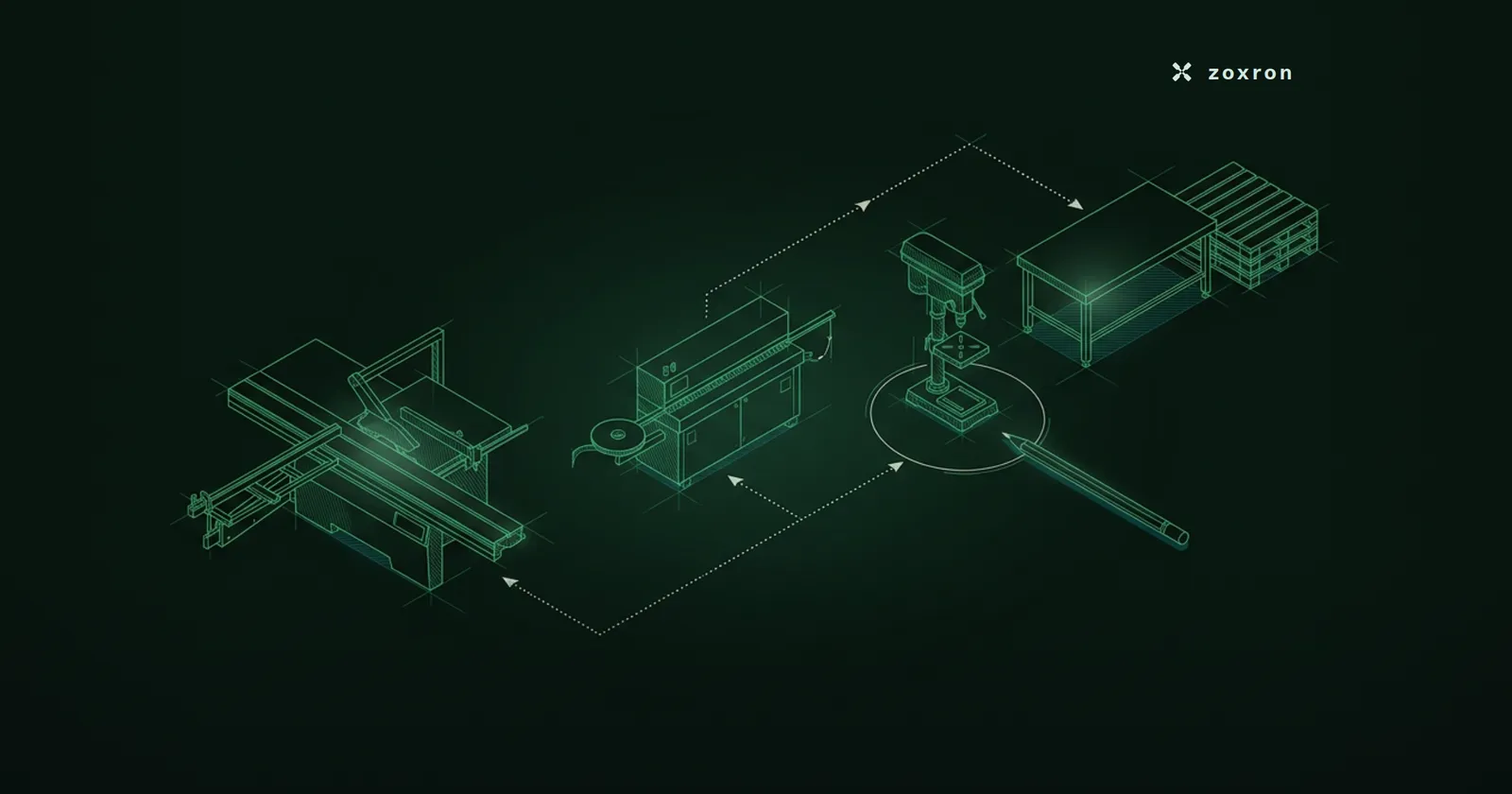
Anyone who has taken a production hall through an ERP implementation knows this conversation. The production director asks the implementer: "You have done this many times, surely you know best how it should work?" The implementer replies: "How would you like it to work?" Each side waits for the other. Workshops get rescheduled, the specification grows, and the project stands still for months while the hall keeps running on spreadsheets.
We recently took over exactly such a project at a manufacturer of board-based products: one production hall, a few dozen people, orders from many countries. This post shows how we got it moving, and what changed on the shop floor once the system started to follow the hall instead of the other way round.
The ping-pong that stalls ERP projects in manufacturing
Nobody in that conversation is lazy. The production director knows the hall down to the last machine, but has never designed an ERP system and should not have to. The implementer knows the system, but has never had to cut a hundred boards before a lorry leaves at six in the morning. Each waits for the other to go first, because each holds only half of the picture.
The outcome is predictable. Questions like "how do you want to handle units?" or "should production be made to order?" bounce back and forth without an answer, because nobody on the shop floor can answer them in the abstract. In the end the system gets set up the default way, and people spend the next year working around it.
Implementers know the menus, not the production technology
The root cause is simple. Most implementers learn an ERP system through its menus: which screen does what, which option to switch on. A manufacturing implementation needs something else first: an understanding of how the product is actually made. Which materials go in, which machines it passes, what gets cut together and what waits for what.
Zoxron's founder is a production engineer who ran a production hall before running ERP projects. That changes where the conversation starts: with the hall, not with the menu.
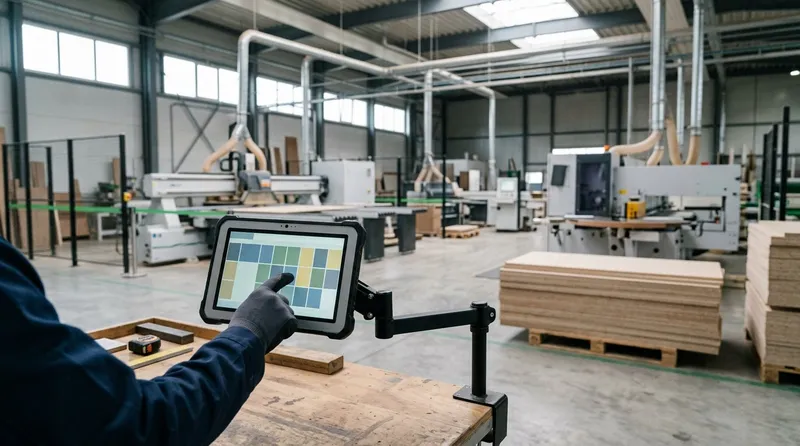
The first move: a draft of the hall, not an open question
Our rule is that the first move always belongs to us, and it is never an open question. It is a concrete draft of the hall inside the system, ready to be corrected:
- Units of measure for selling, buying and producing each product.
- Bills of materials: what each product is made of, and how much of it.
- Work centres: the real machines and stations, with their capacity.
- Routings: the order in which a product passes through them.
A production director cannot design an ERP system, but corrects a ready draft with no effort at all, because they know their hall. "This saw also cuts the other material." "Edging comes before drilling, not after." Each correction takes minutes, and after a few rounds the draft matches reality. The project moves because the hardest part, the blank page, is gone.
Units of measure: customers buy pieces, the system counts square metres
The first draft brought up a problem that had cost the company hours every week. Orders were taken in square metres and converted into pieces by hand, while customers and salespeople actually think in pieces. Every conversion was a chance for a mistake.
The decision: sales and invoices run in pieces. The system calculates square metres from the dimensions of each piece, so the price per square metre and a square-metre calculator stay available to help the customer, without being a second unit someone has to keep in sync. Production works in technical units: pieces, running metres, kilograms.
Suppliers were the other half. Some invoice in a different unit than the one on the purchase order, for example square metres against running metres. Now the system remembers the conversion for each supplier and product, and once a person has confirmed it a few times, it matches those invoices on its own.
The effect in 2026: about 99.5% of order and invoice lines run in a single unit, and nobody corrects units on invoices by hand any more. Before, that was a routine part of the job.
Every production order knows its customer
The second gap lay between the system and the way the hall works. A standard ERP creates one production order for the total shortage of a product and has no idea who it is for. The hall works the other way round: one order, one customer, one delivery note.
The standard "make to order" option looks like the answer, but in practice it adds clicks: an order for every sales line, manual merging of orders so they can be cut together, changes to the sales order that never reach production, and no use of what is already in stock.
So we built a middle way. A person clicks "replenish" once. The system splits the need by customer, starting with the most urgent shipment, matches each order to its delivery note and arranges reservations by delivery date. Semi-finished parts go into a shared pool, because that is how cutting pays off. Only the finished product carries the customer's name.
The result: every open production order for finished goods has a customer assigned. Of the 97 orders completed since October, 95 left with a delivery note, and the other 2 were made for stock on purpose. Nobody has had to correct a recipient by hand.
Fewer clicks matter more than a pure standard
We like the standard. It is cheaper to maintain, easier to upgrade, and most of this system runs on it. But the standard is a means, not a goal. When following it moves work onto people, through extra clicks, conversions and manual corrections, a solution of our own makes sense. The test is simple: after the change, does the person on the shop floor or in the office do less than before?
That only works if the data stays in one place and anything we add is planned to move with each new version. We wrote about both in Odoo is the bucket. Build around it. and Odoo moves your data. We move your system.
FAQ
Doesn't a ready draft push the company into someone else's way of working?
No. The draft is a starting point to correct, not a decision. The people who know the hall change it, and in our experience they change more in the first hour with a draft than in weeks of workshops with an empty system.
Can we keep selling in square metres?
Yes, if that is how your customers buy. The point is one unit for sales and invoices, with conversions done by the system instead of people. Which unit that is depends on your market.
Is a custom solution harder to maintain than the standard?
It takes more care than the standard, which is why we build one only where the standard moves work onto people. Everything else stays standard, and what we add is planned to move with version upgrades.
If your ERP project in production is waiting for someone to make the first move, let's talk. We start with a draft of your hall. More about how we work on the services page.