
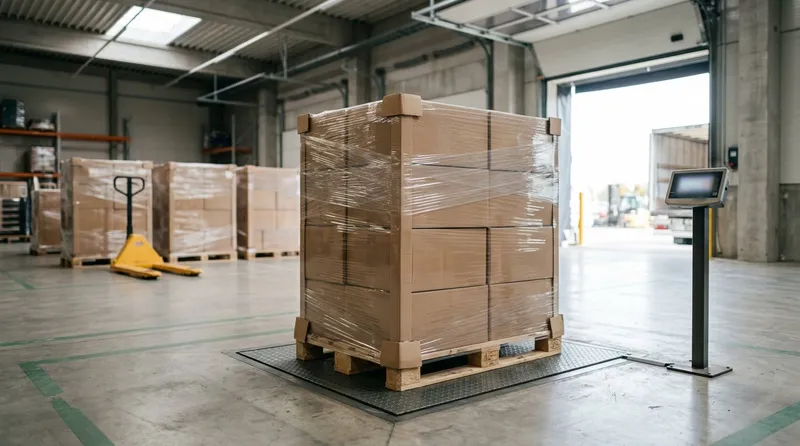
Every shipment from a manufacturing company leaves on a pallet, wrapped in stretch film, with cardboard corner protectors. Nobody thinks of that as a product. It is just how goods arrive in one piece. The law sees it differently: pallets, stretch film, corner protectors and cartons are transport packaging, and whoever places products in them on the market has obligations, reports and fees.
We recently worked through this with a furniture manufacturer that ships at home in Poland and abroad. This post shows what we found, why it is a typical picture in manufacturing, and how a packaging report can come straight out of the data the company already holds in its system.
Pallets and film are packaging, even if nobody sells them
Packaging is defined by its function, not by whether anyone pays for it. Anything that protects goods, lets them be handled and gets them to the customer is packaging. In a manufacturing company that mostly means:
- Pallets: wood, often the largest mass in the whole report.
- Stretch film and strapping: plastics.
- Corner protectors, layer pads and cartons: paper and board.
In Poland, where this client is based, a company placing products in such packaging on the domestic market needs an entry in the BDO register, has to secure recycling (on its own or through a packaging recovery organisation) and files an annual report by 15 March. If the required recycling levels are not met, it pays a product fee: packaging mass x required recycling level x rate. The rates are PLN 0.30/kg for wood, PLN 2.70/kg for plastics and PLN 0.70/kg for paper. Other EU countries run their own versions of this EPR packaging scheme, with the same basic logic.
The typical picture: only a fraction of what ships gets reported
On paper, everything was in place: the BDO entry, a contract with a recovery organisation, a yearly declaration. The problem was in the numbers. For a whole year the company had declared a few hundred kilograms of film and zero kilograms of wood, while roughly a thousand pallets a year leave for domestic customers.
Nobody was hiding anything. Nobody was counting pallets and film from shipments, that is all. The declaration was put together once a year, in a spreadsheet and by eye, and pallets simply never made it into the sheet. In our experience this is common: people think about packaging when they order film, not when they file the report.
With a thousand pallets, even a light pallet adds up to well over ten tonnes of wood a year, and a few hundred grams of film per pallet is clearly less than wrapping a load usually takes. The gap between the declaration and reality is not a rounding error.
The product fee is small, the penalty for incomplete data is not
The good news: at this scale the fee itself, even on the full mass, usually comes to thousands of zloty a year. The real risk sits elsewhere. A company that meets its obligations through a recovery organisation and has not given it complete packaging data can be fined between PLN 10,000 and 500,000 by decision of the environmental inspectorate.
So our recommendation was simple and cheap:
- Weigh a typical pallet of each kind and the film used per pallet.
- Calculate the annual mass from shipments by material, instead of estimating it from film invoices.
- Correct the data with the recovery organisation on the company's own initiative, before anyone asks.
Shipping abroad: the country and the type of customer decide
Packaging that left the country in the same year, as an intra-EU supply or an export, is excluded from the Polish obligations, provided the company holds the shipping documents. That does not mean there are no obligations abroad. There, the destination country decides who is responsible for the packaging, and in practice so does the question whether the customer is a distributor who resells the goods or an end user, along with the delivery terms.
An example from the largest market in the region: in Germany, the VerpackDG replaced the VerpackG on 12 August 2026, and packaging producers register in the LUCID register. When goods go to a German distributor, the obligations usually sit with the distributor. When they go directly to a business that uses them up, the obligations can sit with the sender. Without data on who is who, a company cannot even tell where it is liable.
PPWR: single-use pallets are the biggest risk for 2030
The EU Packaging and Packaging Waste Regulation, PPWR (EU 2025/40), has applied since 12 August 2026. The date that matters most for manufacturers, though, is 1 January 2030. From then on, transport packaging in deliveries to other businesses within the same country is to be 100% reusable, and 40% in cross-border deliveries within the EU. Stretch film and strapping are exempt from the 100% target, cartons from the reuse targets altogether. Pallets are not.
For a company that ships on single-use pallets, this is the biggest future cost risk in the whole packaging topic. A few years is not long to move to reusable pallets or a pallet exchange or pooling system, so planning should start now. The first step is the same as for the report: knowing how many pallets, of which kind, actually leave, and where to.
A packaging report from data the system already has
A manufacturing company already has everything it needs in its system: every shipment, every customer, the delivery country and the number of pallets. What was missing was the link between that data and the packaging. For this client we built it into their Odoo:
- Every shipment converts into kilograms of packaging by material: wood, film, cardboard.
- The system takes the delivery country and customer type into account and shows where the company is liable and where the customer is.
- Declarations live in the system together with corrections, and the summary for the annual report and for the recovery organisation is ready without a spreadsheet.
- Foreign partners get summaries for their own declarations, and customers' statements about their role are collected in one place.
- Missing data shows up straight away, for example a pallet without a weight, before it turns into an error in the report.
The system starts on estimates, and once the company weighs its pallets and film, the measured figures replace the estimate. From then on the packaging report builds itself from day-to-day shipments, instead of once a year in Excel and by eye. It is the same principle we described in ERP implementation in manufacturing and in Odoo is the bucket. Build around it.: the data sits in one place, and reports follow from work the company does anyway.
FAQ
Do pallets we make ourselves count too?
As a rule, yes. Whether something is packaging depends on its function, not on whether the pallet was bought or made in-house. Pallets that come back to the company and circulate many times are treated differently, which is why it pays to know which ones they are.
Doesn't the recovery organisation handle this for us?
A recovery organisation takes over the recycling obligation and the reporting, but it works with the data the company gives it. The company placing the products on the market is responsible for that data being complete. That is why calculating the mass from shipments stays on the company's side.
Where do we start if nobody counts this today?
Weigh a typical pallet and the film, and count last year's shipments by country. That is a few hours of work, and it gives a reliable mass for the correction and a starting point for the 2030 plan. Rules differ between countries and are still changing, so it is worth confirming the details for your company with an adviser.
If your packaging report is put together once a year in a spreadsheet and by eye, let's talk. We start with your shipments. More on how we work on the services page.