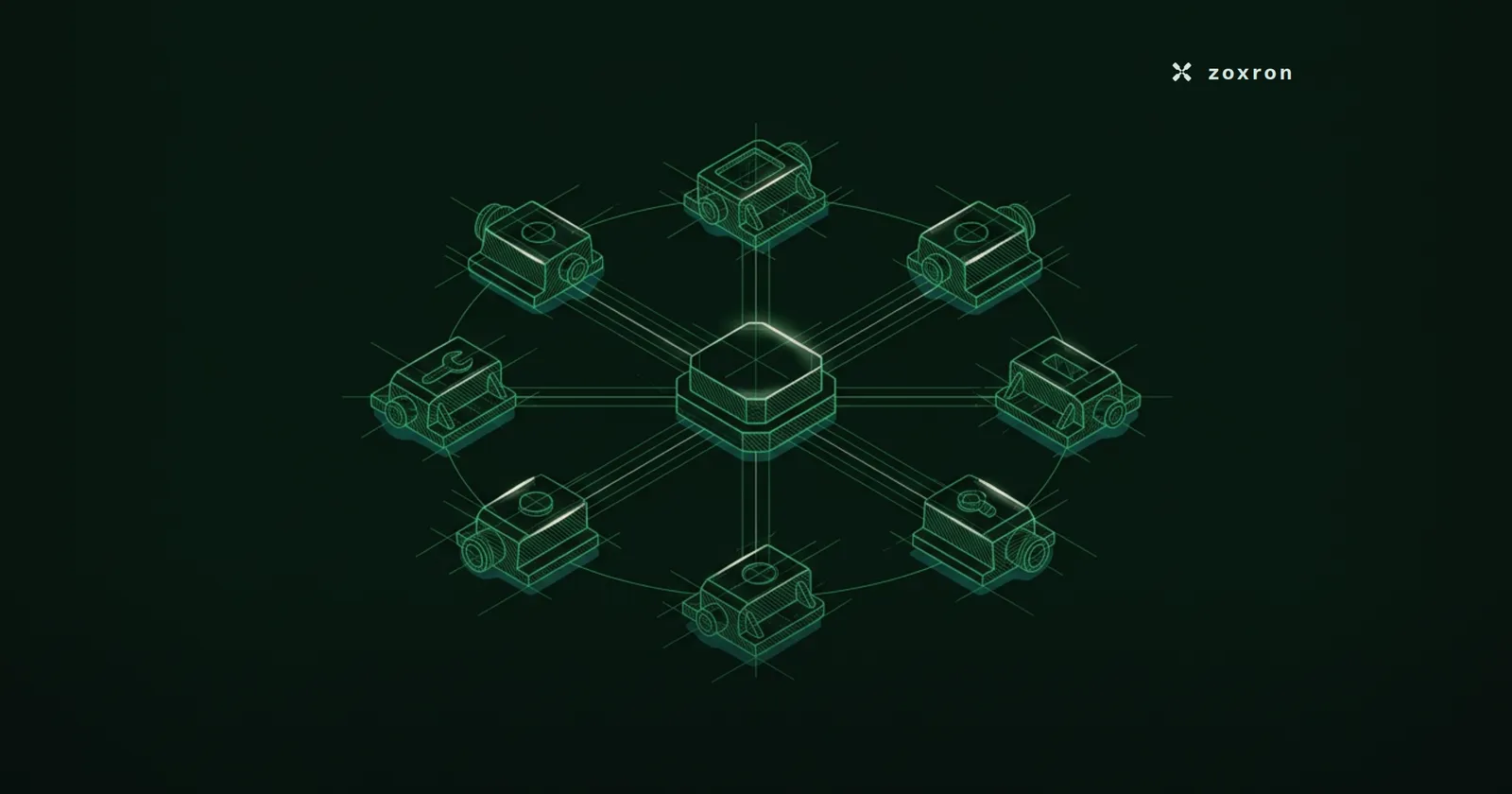
People ask what "Zoxron MCP" actually is, so here's the plain answer: it's an MCP server for Odoo - a set of over 80 operations that your AI agent can call to run Odoo on a server you own. Not a chatbot that talks about Odoo. The actual work: provisioning, installing, migrating, upgrading, backing up and monitoring, exposed as clean actions an agent can take under your supervision. This is a tour of what those actions cover and the gate that keeps them safe.
What an MCP server is, in one paragraph
The Model Context Protocol (MCP) is a standard way to hand an AI agent a set of tools it can call. Instead of writing a bespoke integration for every model and every system, you expose your operations once as MCP tools, and any compatible agent can discover and use them. It's becoming the plumbing of agentic software generally - the same pattern the big ERP vendors are adopting. An MCP server for Odoo applies that idea to the operational lifecycle of a self-hosted instance: each thing an ops person would do becomes a tool with clear inputs, a preview, and a confirmation step.
The four things it covers
The 80-plus tools group into four layers that together span the life of an Odoo deployment:
- Provision - stand up hardware (including cloud VPS provisioning), prepare the base system, and install a fresh Odoo instance with its database and configuration.
- Migrate - move an existing instance between servers with inspection, server-to-server transfer, completeness validation and rollback, the way the migration piece describes.
- Upgrade - step a database across versions (17 to 18 to 19) or across editions (Community to Enterprise), rehearsed on a throwaway copy first; for Odoo 20, your data moves into a new 20 database instead.
- Run - configure scheduled off-site backups, verify they restore, set up monitoring and health checks, and manage TLS and domains.
That's the plumbing an ops specialist would handle, turned into discrete actions an agent can call one at a time. You describe the outcome; the agent maps it to the right sequence of tools.
Preview-first, always
The part that matters most on an MCP server for Odoo is not the number of tools - it's the gate in front of the dangerous ones. Every destructive operation is preview-first. Before it runs, the tool returns a preview: the plan, the exact commands, and the blast radius - what gets changed and what gets touched. Nothing executes until you confirm. In practice this means a mutating tool defaults to a dry run; it shows you what it would do, you approve, and only then does it run for real.
This isn't a politeness feature you can switch off. The confirmation is enforced in the tool itself: the destructive call literally won't fire without the approval that follows a shown plan. That's what makes it safe to give an agent this much reach - the design assumes the agent might misunderstand the task, and puts a human veto in front of every consequential step. There's a whole piece on why that gate is enforced rather than optional.
Monitoring and backups included
A running ERP isn't done when it's installed - it's done when it's watched and recoverable. So the run layer treats backups and monitoring as part of provisioning, not a later add-on. When the agent stands up an instance, it can schedule backups that are pulled off the box so a server failure can't take them with it, verify that those backups actually restore, and wire up uptime and health monitoring that tells you about trouble before your customers do. The reasoning behind doing this on day one is in backups, monitoring and a tested recovery.
Bring your own agent
The MCP server connects to the AI agent you already use rather than shipping yet another assistant. You have a conversation - "move this instance to a bigger box", "upgrade us to 19", "set up nightly backups" - the agent proposes the concrete steps, and you approve them. The infrastructure work that used to require a specialist becomes an auditable exchange: you can see what was proposed, what you approved, and what actually ran. If you want to try connecting your own agent, start at Zoxron MCP.
It's worth being clear about what this is not. It isn't a replacement for judgement on a genuinely bespoke implementation, and it isn't a black box that runs your ERP autonomously while you look away. It's the opposite: the routine, high-stakes lifecycle work - the part that's the same for everyone and easy to get wrong - turned into named actions your agent can take, each one gated behind your confirmation. That framing is why it fits an owned, self-hosted setup so naturally: the tools do the plumbing, you keep the control and the data.
FAQ
What is an MCP server for Odoo?
It's a set of tools, exposed over the Model Context Protocol, that lets an AI agent perform real operations on a self-hosted Odoo - provisioning, migration, upgrades, backups and monitoring - rather than just answering questions about them. Zoxron MCP is an MCP server for Odoo with over 80 such operations.
Can an AI agent actually run Odoo safely?
Yes, provided every destructive action is gated. On Zoxron MCP each risky tool defaults to a preview that shows the plan and commands, and nothing runs until a human confirms. The agent proposes the work; you approve it. That preview-first design is what makes agent-run infrastructure safe rather than reckless.
Do I need to use a specific AI assistant?
No. Because it speaks MCP, the toolset connects to the compatible agent you already use. You describe the outcome you want, the agent maps it to the right operations, and you confirm each consequential step.